


BigCommerce had an unusual 2026. The company behind it now operates as Commerce and trades on Nasdaq as CMRC, with BigCommerce as one of three products alongside Feedonomics and Makeswift. Its headless storefront framework, Catalyst, matured. And management has bet heavily on one idea: that product data feeding AI shopping assistants will matter as much as the storefront itself.
Here is where the platform stands, and who it suits.
One company, three products
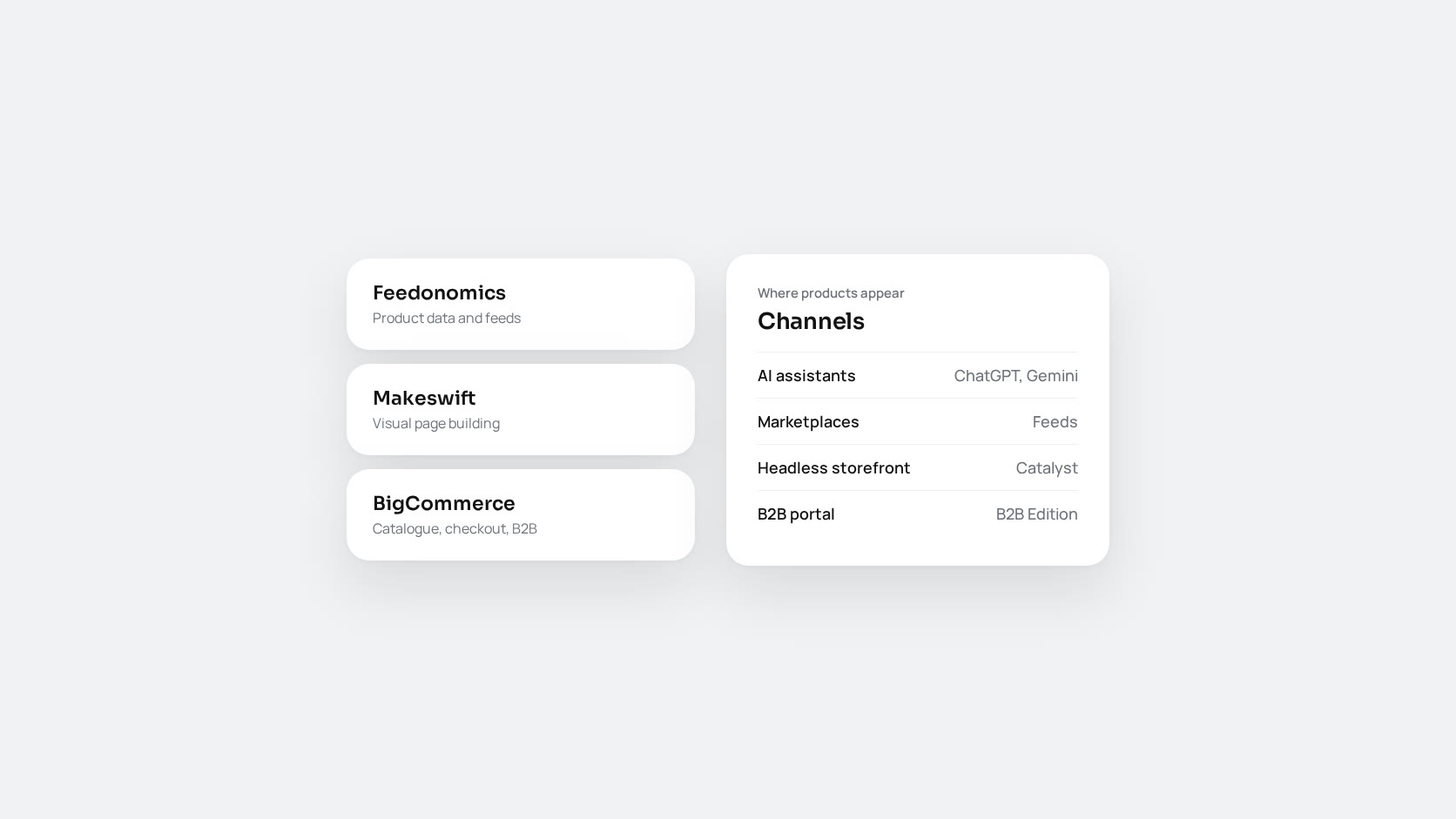
The company describes its business as three “control planes”:
- Feedonomics for product data: cleaning, enriching and sending catalogue data to marketplaces, ad platforms and now AI assistants.
- Makeswift for digital experiences: a visual editor that lets marketing teams build pages on top of headless storefronts.
- BigCommerce for transactions: catalogue, cart, checkout, orders and B2B workflows.
For merchants, this matters because the products can be bought separately. Feedonomics in particular is used by many brands that do not run their store on BigCommerce at all.
The agentic bet
In April 2026 the company said merchants, including Dell, had started sending catalogue data to AI discovery channels such as OpenAI and Google Gemini using Feedonomics Agentic Catalog Exports. More data enrichment products for AI channels were planned for the second half of the year.
This is the same direction Shopify took with its Agentic Storefronts, approached from the data side rather than the storefront side. The underlying point is the same on both platforms: an assistant can only recommend what it can read and trust, so catalogue quality becomes a sales lever.
Catalyst and headless
Catalyst is BigCommerce’s open-source storefront framework, built on React and Next.js. It gives teams a production-ready headless storefront that is already wired to the BigCommerce APIs, instead of building one from scratch. Releases through 2026 added features such as tax display settings and kept up with Next.js security updates, and BigCommerce has been building native hosting for Catalyst so merchants do not need a separate hosting provider.
Headless is not free. It adds a frontend codebase to maintain, deploy and secure. Catalyst lowers that cost but does not remove it.
B2B is the strongest story
B2B has been BigCommerce’s most consistent strength. In 2026 the company announced tools for complex B2B operations, including AI-driven purchase order automation and cascading price lists, and published examples such as a distributor running a B2B portal with more than 45,000 products connected to an Epicor ERP. Company accounts, quotes, buyer roles and customer-specific pricing are built into its B2B Edition, while on many platforms they need several apps.
The business picture
The numbers are mixed. The company reported second-quarter 2026 results on 6 August with revenue of about $84.5 million and annual recurring revenue of $360.5 million, up 2% year on year, and operating income above its own guidance. Profitability has improved, but growth is slow, and some analysts question whether the subscription business is shrinking while the company focuses on data products.
For a merchant, the practical question is not the share price. It is whether the platform will keep investing in the features you depend on. B2B and data look safe. Standard small-business features get less attention than they did a few years ago.
Who BigCommerce suits in 2026
- A good fit: B2B and hybrid B2B/B2C businesses, mid-market brands that want a SaaS platform with fewer app dependencies than Shopify, and teams planning a headless storefront with a ready-made starting point.
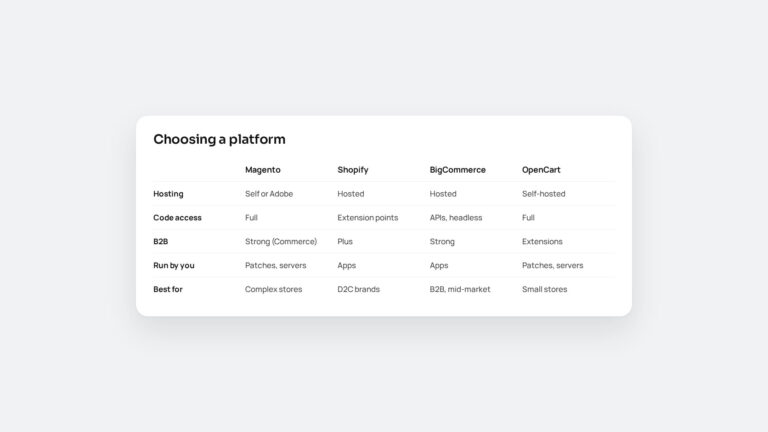
- Think twice: very small stores that would benefit from Shopify’s app ecosystem and simplicity, and businesses with heavily custom logic that need the full code access Magento gives.
As always, the right platform depends on your catalogue, your customers and your team. We compare the main options in our platform guide.