


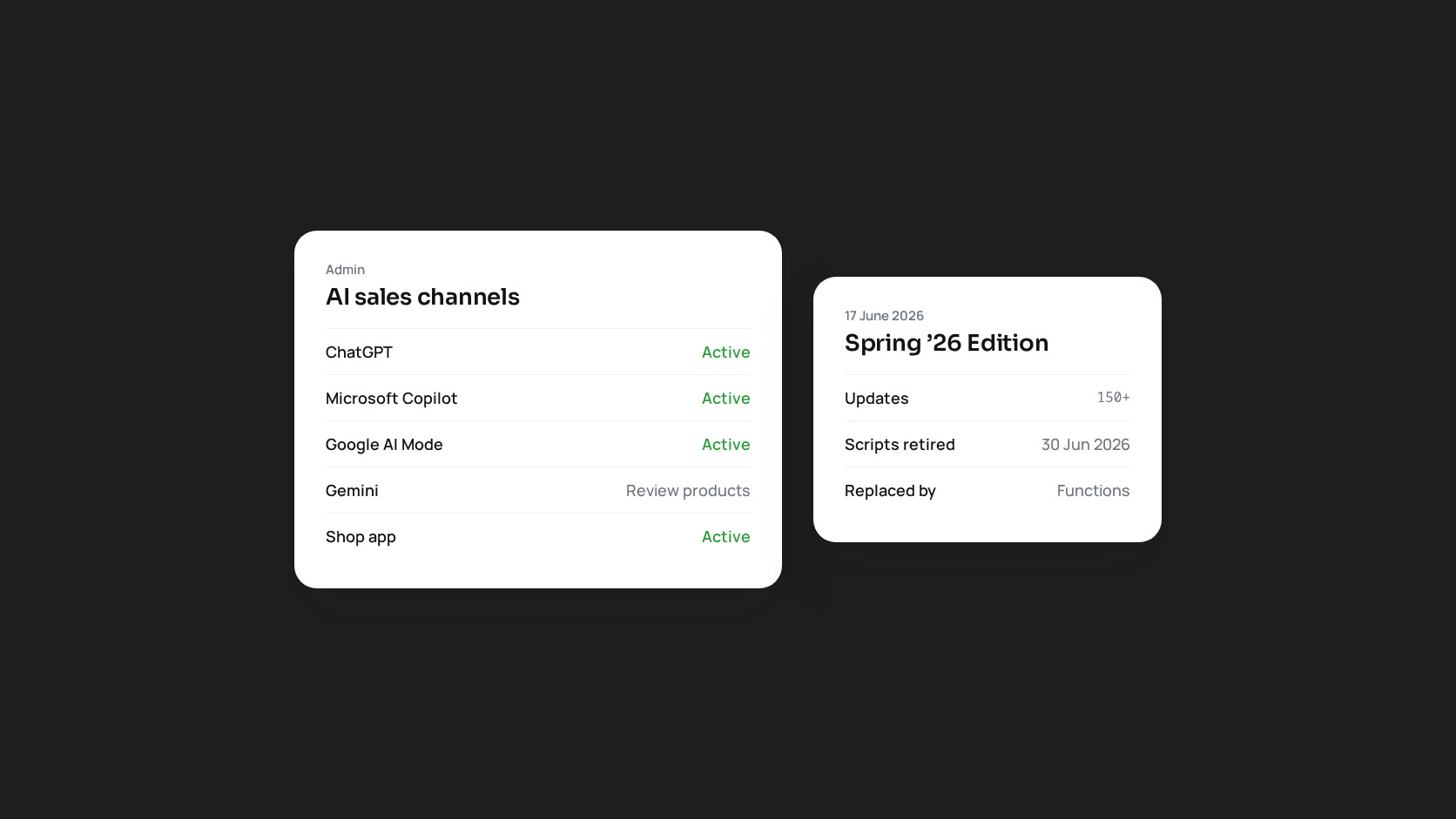
Shopify released its Spring ’26 Edition on 17 June 2026, under the theme of selling, shopping and building “everywhere”. It contained more than 150 updates. Most coverage led with the long feature list. We think the edition is more useful read as one statement of direction: Shopify expects a growing share of shopping to start inside AI assistants rather than on a store’s own website, and it is rebuilding the platform around that.
Here is what changed, what it means for merchants, and what to do about it.
Agentic Storefronts: your catalogue inside AI assistants
The centre of the release is a new area in the Shopify admin for managing AI sales channels. Eligible products can be made available to assistants such as ChatGPT, Microsoft Copilot, Google AI Mode, Gemini and the Shop app, and managed from one place. Reported features include insight into the queries shoppers ask in your category and whether your products appear for them.
Shopify also reported that checkout is live inside Microsoft Copilot, with Shop Pay used to complete the purchase in the conversation, and that checkout in other surfaces is coming.
What it means: product data is now a sales channel in its own right. Titles, descriptions, attributes, variants, stock and policies are what an assistant reads when it decides whether to recommend you. Stores with thin or inconsistent product data will be skipped, whatever their brand or theme looks like.
Sidekick connects to apps
Sidekick, Shopify’s built-in AI assistant for merchants, gained app extensions. Third-party apps, with partners reported to include Klaviyo, Loop, Smile and Judge.me, can expose their data and actions to Sidekick. A merchant can ask a question that spans the store and its apps, such as returns, reviews or email performance, without opening each app.
What it means: when you choose apps, ask whether they integrate with Sidekick. Over time, apps that do not will feel like separate tools.
Building with AI coding agents
For developers, Shopify released tooling that lets AI coding agents, including Claude Code, Cursor and Codex, work with Shopify through an AI toolkit and public MCP servers. In practice that means agents can read documentation, query store data and help build themes and apps inside Shopify’s own guardrails.
What it means: the cost of small customisations keeps falling. It is still worth having an experienced developer review agent-written code before it reaches a live store, especially code that touches checkout or customer data.
Checkout and testing
Several sources reported that Checkout Components became generally available for Shopify Plus, and that built-in split testing for themes and checkout configurations was added. Check the current documentation for your plan before you plan around either, because availability differs between plans.
Shopify Scripts are retired
The most important date of 2026 was not part of the edition. Editing and publishing Shopify Scripts stopped on 15 April 2026, and Scripts stopped running on 30 June 2026. Discount, shipping and payment logic that lived in Scripts must now run as Shopify Functions. If a Plus store’s discounts or shipping rules have behaved differently since July, check that first. We cover the audit in a separate article.
What merchants should do now
- Treat product data as a channel. Fill in structured attributes, write descriptions that answer real questions (materials, sizing, compatibility, care), and keep stock and pricing accurate everywhere.
- Review the Agentic Storefronts settings and decide which products and channels you want to appear in. Not every catalogue benefits equally.
- Check how you will measure it. Orders that start in an AI assistant behave differently from search or social traffic. Make sure your reporting separates them.
- Audit your apps for Sidekick support and for overlap. Each new edition tends to add native features that replace a paid app.
- Confirm the Scripts migration is complete and tested, including edge cases like stacked discounts and B2B pricing.
Our view
It is too early to know how much revenue will flow through AI assistants, and the honest answer for most stores in 2026 is “a small but growing share”. The work Shopify is asking merchants to do pays off either way: clean, complete product data improves on-site search, filters, marketplaces and ads as well. Start there.