


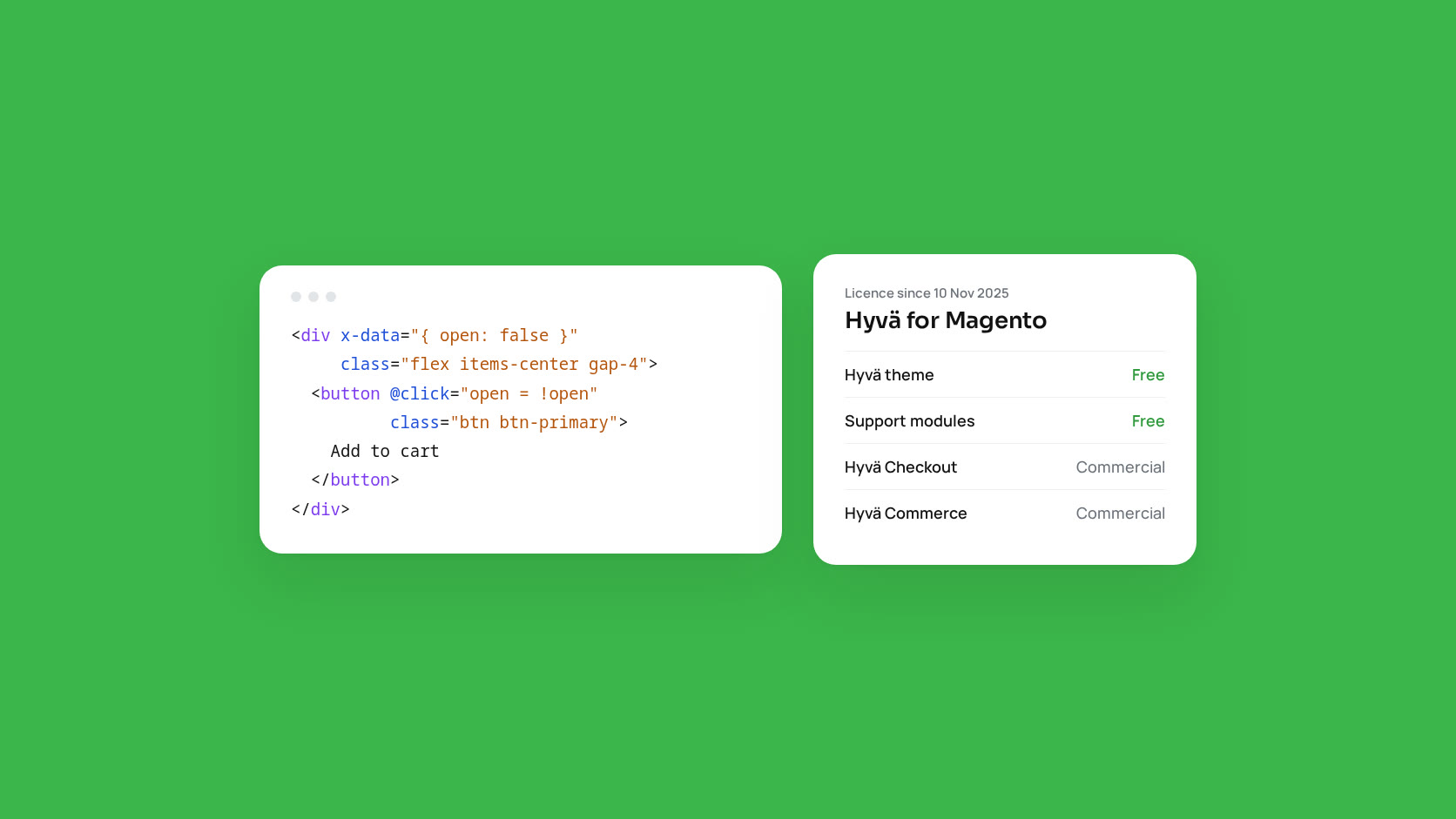
For years, the most common answer to “how do we make this Magento store faster?” was a commercial theme licence. Hyvä replaced Magento’s heavy Luma frontend with a lean stack built on Tailwind CSS and Alpine.js, and stores that moved usually saw large improvements in page weight and Core Web Vitals. On 10 November 2025 the Hyvä theme became free and open source under the OSL 3.0 and AFL 3.0 licences, the same licences Magento Open Source uses.
Almost a year later, the question has changed from “can we afford Hyvä?” to “should we move to it, and when?”. Here is how we answer that for clients.
What is free and what is not
- Free: the Hyvä theme itself and the support modules it needs. They are installed through Composer, with free keys from the Hyvä portal.
- Still commercial: Hyvä Checkout, Hyvä Enterprise and Hyvä Commerce.
That distinction matters for planning. A Hyvä storefront can still use Magento’s standard Luma checkout as a fallback. Many stores do exactly that at first and move to a faster checkout later.
Why Hyvä is faster
Luma loads RequireJS, Knockout.js, jQuery and a large set of UI components on most pages, even when a page needs very little interactivity. Hyvä starts from the other end: server-rendered HTML, a utility CSS framework that ships only the classes in use, and a small JavaScript library for interactions. Fewer, smaller files mean less work for the browser, especially on mid-range phones, which is where most stores lose mobile shoppers.
Where the real cost is
The licence was never the expensive part of a Hyvä project. The work is:
- The theme itself. Your current design is rebuilt as Hyvä templates. Luma customisations do not carry over.
- Extension compatibility. Any extension with frontend output, such as product options, reviews, search, sliders or loyalty, needs a Hyvä-compatible version. Most popular vendors now offer one, and Hyvä maintains a compatibility tracker. Bespoke modules have to be adapted.
- Testing. Every customer journey has to be checked again, on real devices.
For a typical mid-sized store, the extension audit decides whether the project takes weeks or months. Do it first.
When it is worth it
- Yes, usually, if mobile performance is costing you conversions, your Luma theme needs a redesign anyway, or most of your extensions already support Hyvä.
- Not yet, if you depend on several extensions with no Hyvä support and no alternative, or if the store has bigger problems to fix first. A slow database or a broken cron setup will not be fixed by a new frontend.
- Combine with an upgrade when you can. Moving to Magento 2.4.9 and Hyvä in one planned project shares the testing effort, as long as both are tested together on staging.
Measure before and after
The business case for Hyvä is a performance case, so measure it properly:
- Record field data (Core Web Vitals from real users, not only lab scores) for home, category, product and cart pages before you start.
- Record the conversion rate on mobile and desktop separately.
- Repeat both measurements a month after launch, over a comparable period.
Server response time matters too. Hyvä makes the browser’s work lighter, but it cannot fix a slow backend. If uncached pages take two seconds to render on the server, look at that first. Full-page cache coverage, slow queries and indexer state are where we usually start.
What this means for the Magento ecosystem
A free, fast default frontend removes one of the most common arguments for leaving Magento for a hosted platform: “Magento is slow”. It also raises expectations. With Hyvä free, a slow Magento storefront in 2026 is a choice, not a limitation of the platform. For merchants who have the right team or partner, that is a strong reason to stay on Magento and invest in it.
If you are weighing a Hyvä migration, we can audit your extensions and give you a realistic scope before you commit.